Expressing Contemporary Zeitgeist: Evolution and Self-Discovery
October 7, 2008
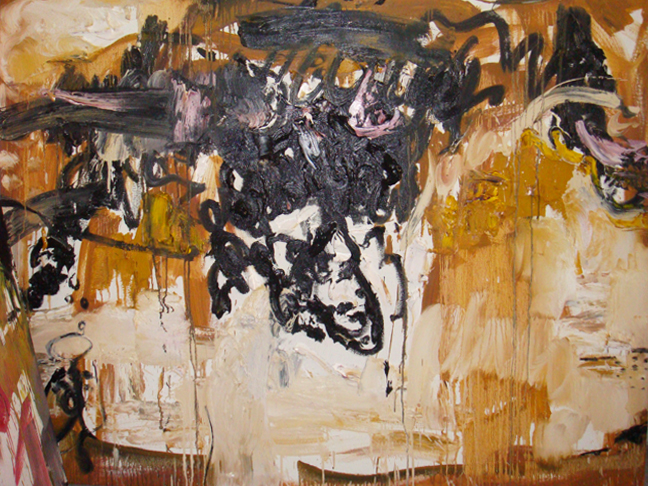
Zhang He’s paintings convey a very contemporary sense of urgency, unrelated to geographic location or to particular human drama. The very eventful treatment of colour expresses a world of opportunity, perhaps laced with anxiety in some readings of the meaning of his almost abstract canvasses. A line of narrative is not even hinted at; a distinct atmosphere is rather exuded by the pictorial surface. Eroticism is very present: a very masculine – yang – form of it, through colour that seems placed under siege, assaulted by concerted efforts of brush and spatula.
Dashes of black, dabs of white are injected into the colour networks with a measure of randomness, alluding to light and darkness, but, more broadly I suspect, to the alternative appearance, or to the coexistence of good and evil within man, and within the body social.
Nooks and crannies pop up within the quickly-shaped paint surfaces; cracks, subtle depressions: these may point to a sudden impasse in the painterly movement, yet – symbolically perhaps – to yin cravings, to female signs. Sexual overtones seem palpable.
In all its guises, colour is present. A dizzying variety of primary and secondary hues pervades the canvass, both ordered by Zhang’s consummate sense of colour harmony, and by other forms of aesthetic necessity: for instance, that of a jarring disharmony dictated by painterly impetus. Paint is applied in a great variety of ways: streaked, kneaded, piled, scored, scarred, gashed, marked, shredded… In Zhang’s very recent painting, don’t search for regularities in the application of pigment: spirals and trajectories, traces of calligraphy break up fields of paint in a way that subtly frustrates visual expectation.
Expressing the needs of the psyche
The language of colour and line reveals in Zhang’s recent work, an attempt to come to terms with profound, pressing needs of the psyche. These canvasses – particularly the ones painted in Canada – express a great sense of urgency, displayed by the intense energy of execution. The canvass becomes the evidence of a dance, of the performance of the act of painting on canvass, called action painting. In 1952, American art critic Harold Rosenberg in fact described the canvass as “an arena in which to act.”(1) In tune with the vibrant act of painting, Zhang’s personality is assertive, individualistic: he resolves doubt in the optimism of action. Nevertheless, he is practicing oil painting, using a medium with its inherent conservative laws: the limits of Zhang He’s action are those that the painterly technique allows.
His restless artistic spirit catches an aspect of the spirit of our age: not only of North America, but of his native land, of China today. Many people in Canada, the USA and China, find motivation and pleasure in Zhang’s dynamism of texture, colour and line. He provides a vision in tune with a sometimes contradictory, mostly fast-paced social environment.
A lyrical note from the Chinese tradition
And yet – under a surface that may be quite stormy, a distinct lyrical note resounds in Zhang He’s painting. His art subtly belongs to the encompassing Chinese tradition. Still, the outline of landscape, the traces of still life are nearly always present in Zhang He’s artistic vision: they express the age-old preoccupation of Chinese art with the mysticism of nature. It provides an underlying substratum for the post-modern jazz feeling of Zhang He’s compositions.
Classical Chinese painting, which can be followed back to the T’ang dynasty (seventh to tenth century A.D.), or even further in time to the Han dynasty (third century B.C. to third century A.D.), is greatly concerned with feeling. Even in the most painstaking views of landscape, the painter’s emotion is almost always expressed. By contrast, a certain objective view of nature forms a subtle standard in the Western tradition, highlighted by Renaissance landscape. In the Chinese tradition, cosmogony, the reality of landscape (or that of still life), as well as the painter’s feelings, are almost in a state of fusion. This creates the mystery, the fascination of good Chinese painting, in the classical tradition. Not analysis, but unity of feeling, while its quality of observation may nevertheless possess the sharpness of a hawk’s vision.
Zhang-He works in a very personal, post-modern painterly idiom. On the surface of the issue, he seems extremely far removed from the Chinese classical tradition of painting. Nevertheless, the concern for feeling remains.
Nineteenth century English and French nature painting also intended to capture the fleeting sensation. Abstract expressionism in America, in the forties and the fifties of the twentieth century, made feeling into a kind of law. Traditional Chinese art always possessed the immediacy of observation, combined with the immediacy of the painter’s emotion. Zhang He cultivates this quality to the highest degree: it is the cornerstone of his painting, as it were. In a clear sense, while his present painting appears deeply connected to the lineage of American abstract expressionism – and particularly to the realm of action painting – Zhang He’s art also emerges directly from the very long tradition of Chinese painters, who instinctively record their most minute emotion when faced with a subject.
“My feeling on a given day”
Thus Zhang He describes his basic approach to a theme: “It’s about my feeling on that particular day“. Just as the impressionists, or, as certain expressionist painters, he stresses the importance of the unique retina sensation: the one that, in a transformed manner, will be consigned to the canvass. As he quickly lays down the essence of feeling – with extreme vigour – in accordance to his temperament, he stresses the overwhelming importance of light. “I am sensitive to sunlight coming into the room, to its angle”, he says. Many of his abstract or almost abstract colour compositions possess a glow that subtly translates the obsession with light.
A deconstructed theme – for instance a deconstructed landscape or the impression of a city view – are seen by Zhang He as touched by a certain phase of daylight: that angle, that vision forms the basis for the quick, often fractured, eventful canvass impression. The light, the angle of vision, the reaction to the fleeting impression, come together to form the spontaneous artistic image.
A series of expressionist self-portraits by Zhang-He also aims to capture fleeting emotion – rather than pictorial objects – related to the inevitable ups and downs, to the caprice in an artist’s career: facial expressions by turns, melancholy, hopeful, weary, triumphant, desiring, quizzical…
Searching for an artistic philosophy
To capture Zhang He’s motivation, the stimulus at the root of his plastic vision, artistic evolution seems to be a fitting, almost irresistible category. Zhang He is a native of Shenzen, a large Chinese city north of Beijing, towards the border with Siberia. At the age of fifteen, Zhang He was already sketching, painting in record time true-to-life portraits. He attended art-university in his home city and became proficient in Chinese pictorial realism, a version of the social realist Soviet model. As was the case with many other artists, even a great lesson of technical painting skills, once absorbed, became a model to be shunned, in order to attain one’s expressive potential.
In the artistic effervescence of post-Maoist China – as many of his generation – Zhang He was searching for a new philosophy for his art. In step with the times, we can see that successful mainstream Chinese artists, chose, among other trends, narrative ironic conceptual forms of painting – as in the case of Zhang Xiaogang; conceptual calligraphies, such as those of Xu Bing; violent expressionist critiques of the effect of state power on personality, as did the painter Yang Shaobin.
Zhang He, very naturally harks back to sensitivity to nature, the wellspring of Chinese art for at least thirteen hundred years, to this great achievement of Asian art – and, indirectly, to an important theoretical source for the 20th century renewal of modern Western art. But gestural lyricism is intricately tied to the root of Chinese calligraphy, to the immemorial sensibility of the Chinese people. For a Chinese artist, the most natural act is to be inspired by his own fecund pictorial past. When Zhang painted landscape and still life, in accordance with his passionate, assertive temperament, he did so in the lineage of a kind of Chinese baroque, represented by Chu Ta (seventeenth century) or by the Eight Eccentrics of Hang Chou (in the early eighteenth century), whose spirited painterly language showed at times gnarled tree trunks and stems (Kin Nong), or bamboo shoots. (Li Chen) Theirs was called “the hasty work of the brush” and was sometimes criticized by conservative critics.
In Zhang He’s images of vases, flower arrangements, shrubs, the colours tended to intensity, to saturation; line-work was sinuous or ruptured, as in the work of Western painters Nolde or Soutine. As though carried away by an oceanic movement (or inner feeling), flowers seem to want to reach out of the canvass. In the line of classical Chinese painting, the painter’s psyche, which also belongs to a more general collective family of temperaments, is powerfully projected on the canvass using natural motifs. The painter allowed this notable phase in his artistic development to flower in Canada.
Significantly, lyrical, albeit intense nature painting – in a recognizable figurative mode – is still part of Zhang He’s repertory. He goes back and forth between pure gestural abstraction and expressionist nature painting. He cultivates great mobility between themes of painting and personal stylistic registers.
Zhang He’s North-American reality
In 1998, Zhang He immigrated to Canada, where he found increased liberty of artistic exploration. “In Canada, I have more freedom to express myself”, Zhang He says emphatically. “When I came to Canada, I was influenced by the beauty of the colours of landscape”, he adds. Gestural colour painting indeed fitted the mood of the Quebec landscape, and Zhang He’s thirst for colour, as well as his emphasis on brush movement and on texture. He expresses in strong, broad gestures the golds, browns and reds of Eastern Canadian landscape. Meanwhile, in the Chinese lyrical ethos, he continued to develop representations of personal emotion in intensely erotic images of flowers, bouquets, vases.
After 2004, expressionism gives room to abstract expressionism as Zhang He increasingly shuns figurative form, or leaves the mere trace of it on canvass. The painterly gesture becomes more intense. There is a greater struggle with paint and pictorial surface. Zhang He lays increased emphasis on spatula-work, he explores textures and the sculptural nature of paint. The subtle evocation of sculpture, the new, hybrid quality his paintings exude – especially those created in Canada – are elements that correspond to a new post-modern mood in his art. Zhang He’s painting subtly adapts to time and to surroundings, in analogy perhaps to the way he also catches on canvass the “animistic” fine mood of nature, and even that of apparently inanimate environments.
The artist avidly frequents North American museums and galleries – he particularly relishes his visits to New York City – while absorbing US and Canadian pictorial practice. Such active study leads to the liberation of colour and texture. He partakes in an intense universal tendency towards mutual cultural discovery, brought about by globalization.
The Gesture is of the essence
Zhang He’s painting possesses a quality opposite to what is defined as Platonic. It’s all about earthly reaction and commitment. Close to emotion and to sensation, it is inscribed in the time and the place where it is produced. French critic Pierre Restany’s phrase seems very apropos with regard to Zhang He’s implicit credo: “Painting is a moral act. The painter is the philosopher of his own action.”(2), rather than being, should we say, the illustrator of some literary doctrine. Restany was writing about the emergence of American abstract expressionism from European roots. In the work of some of the painters of the New York School from the nineteen fifties, such as Jackson Pollock, the painterly gesture was of the essence, and so it remains in Zhang’s work. Norwegian art critic Øystein Usved calls the painterly gesture “a rhetorical figure of speech.”(3) It tells us a lot about Zhang He. While Zhang He’s painterly gesture is instinctive and quick, it is the opposite of what could be called serial. This often hectic gesture also undergoes constant renewal.
In the classical Chinese tradition, the artistic space is dreamily remote, set apart from the viewer, as opposed to expressionistic pictorial space, which is less volumetric, more two-dimensional, so as to favour involvement with the subject matter. That is the pictorial space Zhang He now occupies. He moved gradually from the representation of plant and still life, albeit in an expressionistic manner reminiscent of the “Chinese baroque”, towards a more abstract gestural expression. As the paintings turn more abstract, the gesture is also more clipped, nervous, varied, unpredictable, and in tune with Zhang He’s anxiety and optimism of action – optimism is other side of the coin, as it were.
Exploring new terrain: post-modernism
I see his present stance as the outcome of a series of renunciations. He renounces the cursive nature of calligraphic line and increasingly adopts procedures such as scraping, piling paint, gashing the surface etc. He renounces figurative representation in favour of abstraction. He renounces harmony – for which he has a talent: it is part of his fascination with nature – in order to explore jarring, inharmonious effects, which increase the harshness of the aesthetic rhetoric. Cracks and gashes often criss-cross the colour fields. He temporarily renounces lyricism in favour of a very contemporary message of urgency.
The unity of the pictorial surface is broken and so is the unity of message. The recent paintings often leave the impression of post-modern hybridity, and perhaps they are further away from nature than were previous paintings. The classical Chinese ethos that was underlying his still lives gives way to the more dissonant contemporary, anxious and curiously ironic Chinese voice, at once more individualistic in a “Western” sense and bolder, more entropic. Zhang He is engaged on a voyage of “liberation”, self-discovery, of unearthing some hidden voice and potential. The vigorous work with texture, the isolated trails of paint and impastos – like exclamation marks – reflect this point. Recent canvasses, such as Christmas Party, Kindergarten, L’Amour partake in this phase.
The painter defies the traditional Chinese balance of yin-yang energy in the aesthetic space. Sometimes there is more yin – while paintings mostly exude more yang – but, observing many paintings side-by-side in Zhang He’s Montreal studio, one perceives, especially in those canvasses executed in Canada, a jubilatory and powerful energy. Those paintings produced in China retain, to some extent, a more shamanic feel for nature, in the lyrical Chinese tradition. Landscape notes are preserved in strong horizontal and vertical axes that connote orchards, river landscapes or forests. Zhang He savours his freedom to move back and forth between registers, to keep flexibility and nimbleness.
In the work produced in Canada, now hybridity is dominating: the unique gesture of Chinese painting is broken. Paint begins to act as a sign, as a form of short-hand, it begins to be a sign for emotion, rather than a direct expression of it. Subtly, graffiti-like gestural entities are interspersed with areas of colour, which probably reflect intense emotion. Textural fields are broken up by streaks and spirals of paint. One is reminded at times of deconstructed Soutine and more cogently, of New-New painting. (a descendant style of New York abstract expressionism that heavily plays on sculptured, thickly-textured acrylic on canvass with distinct light effects) Zhang He remarks that he likes New-New painting for texture, but that he does forego the neat control of image surface and texture, a trademark of New-New painting.
An intense, contemporary feeling
Zhang He is in tune with the contemporary ethos of Chinese art. “Art in China is in fact art created jointly by China and the West”, writes Chinese art critic Leng Lui. “It contains a complex, sensitive, somewhat enthusiastic (and neurotic) response to the interaction of inseparable societies caught up in the process of globalization.”(4) I think that a conceptual model proposed by Russian literary critic Mikhail Bakhtin has the ability to account for aspects of the evolution of Zhang He’s painting, as well as for Chinese art in general, in the present globalized paradigm.
“We must adopt a more sophisticated conceptual framework that allows us to analyse what Mikhail Bakhtin has termed the dialogical nature of art. According to this model, an art work is not a unified whole, but rather an open-ended site of contestation wherein various cultural practices from different classes and ethnic groups are temporarily combined. Any visual language in the arts is thus understood as the locus for competing cultural traditions (…) Consequently, artwork such as that by the Abstract Expessionists should be approached as an uneasy synthesis of hegemonic values with other cultural tendencies…”(5) Allowing for differences of time and place, this passage points out how to approach an expression of cultural synthesis between China and North America, such as that Zhang He is engaged in. It also accounts for Zhang He’s going back and forth between a register closer to the Chinese tradition, and a brasher, more North American influence in his work. There is a “dialogical” negotiation, an adjustment that is never quite completed, thus allowing for continued discovery, evolution, self-discovery.
Abstract expressionism and contemporary versions of it, such as the painting of Zhang He, in their non-verbal fluidity of expression, deal with particular aspects of consciousness which involve a privileged link between the viewer and the work of art. Zhang-He’s painting involves the expression of individual psyche and zeitgeist, the spirit of the age. His assertive artistic individuality has moved beyond a “Chinese narrative”, or “Chinese identity”, into a universal archetype, related to a mood and a personality. He ends up expressing an intense, contemporary feeling to which others- his viewers – resonate. As he moves back and forth between a more “Chinese” and a more international mode, he calls in question notions about national or cultural “immanence”, about an inherent national way of being, in the context of perception and artistic creativity.
References:
- http: poetrymagazines.org.uk the American Abstract Expressionists
- Pierre Restany in La Grande histoire de la peinture moderne L’Aventure de l’art abstrait Éditions Albert Skira Geneva 1982 p. 10
- Østein Usved on Norwegian painter Harald Samuelsen in http : sinkingstudio.com
- Leng Lui in John Clark Chinese Art at the End of the Millennium New Art Medium Beijing and Hong Kong 2000 p.62
- John Craven in Ellen Landau et al. Abstract Expressionism Context and Critique – John Craven Abstract-Expressionism and Afro-American Marginalisation Yale New Haven 2005 p. 512
 André Seleanu