Images of the Cosmos
The wide-ranging pictorial meditation of Silvia Albuixech
July 15, 2016
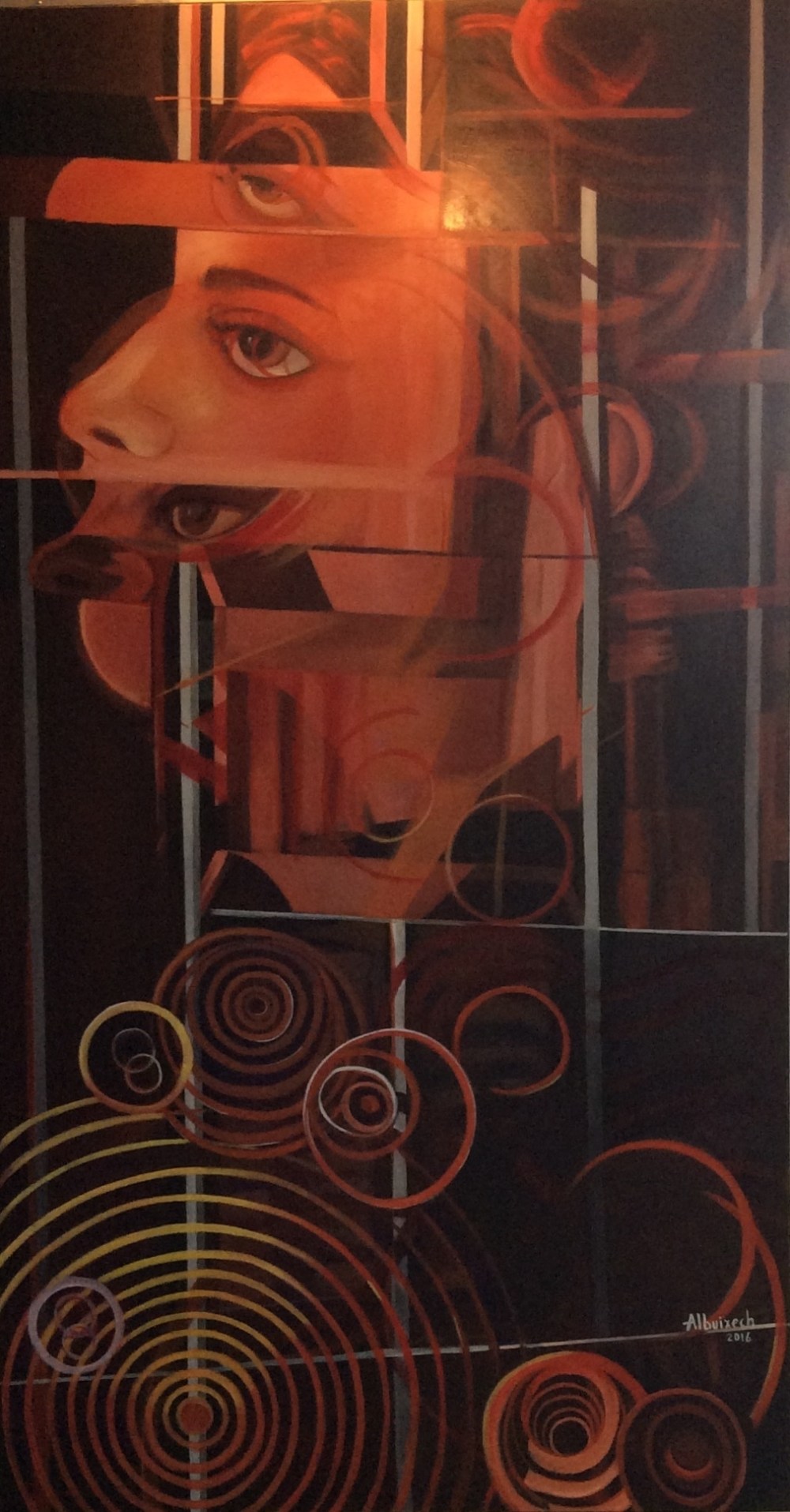
Silvia Albuixech’s pictorial visions strike us as both poetic and exploratory… They show kinship with the surrealist tradition : yet, beyond oniric imagery, they also contain hybrid and discordant elements pointing to existential tensions. While many of her images are fraught with anxiety, there is an overall harmony in the painterly synthesis of hybrid elements. In merging a multiplicity of references quite seamlessly, the work reveals a contemporary sensibility.
These poetic visions are expressed in a wide range of public murals and in a series of paintings presented under the title Portraits of Time (Retratos del tiempo). The evolving pictorial discourse forms the visual equivalent of a flexible, far-reaching essay, or of a philosophical meditation subtly referring to the elusive theme of time, a dimension of existence at once pervasive and highly controversial within the history of philosophy.
The artist’s dialogue with the viewer is centered on images of the Cosmos, on eloquent visual renderings of space, strongly connected to the concept of time. This is achieved via an archetypal treatment of blacks and various shades of blue, sometimes criss-crossed by various lines connoting movement and trajectories. As an additional theme, Silvia approaches the very destiny of our planet from a perspective suggesting geological time – using ochres and blacks – and she extends this open-ended meditation to include life in general – biology – through the well-tuned use of greens and blue-greens. In a way, the geological and biological themes merge into a tangential allusion to primal myth, approached – not head-on – but at its extreme margins… The artist alludes to the role of science and technology with their existential threat – and perhaps their traditional promise- in a manner tinged with some irony and skepticism. The exploration also touches on the violence suffusing existence – and perhaps on gender relations – where menaces are alluded to through the hue of the chromatic background : greys and blacks…
Matching the ambitious vision, the artist has developed a flexible plastic vocabulary of emotionally-charged colour fields, sometimes traversed by precisely traced linear elements, or circles and spirals, and by arrow-like and rectangular shapes. Fragments of disks and rectangular forms have surfaces that turn subtle and complex through variations and gradations of colour brightness and tonality. (shades of green and pink often stand out) Thus the artist injects notes that are akin to cubism in a work dominated by the startling presence of colour fields.
Being able to draw on such a diverse visual panoply, at times Silvia Albuixech seems to propose visions of the existing world – as it appears to her. In other modes of perception, as an underlying alternative current of consciousness – or in a register of expression equivalent to an alternative strand of music – she conjures and creates other would-be realities or pictorial worlds… Personal visions and collective subconsciuous images, underscored by a knowing use of colour symbolism, intersect and fertilize each other. A mode of dialogue is being created between paintings of the series and between murals – and also between the works and the viewer.
The range of expression is essentially abstract, yet it often palpably verges on figuration : then the artist’s ˝dream-like ̋ images evoke birds’ heads, boats, tropical vegetation, mechanical objects such as springs; the emotional register sometimes encompasses signs that may evoke blood stains… This expression is notably related to surrealism, in a way that apparently unconnected elements are brought together in a tenuous synthesis – into conceptual dialogue. This pictorial world is composed both by meditative free- association – by images that seem « to take flight » together – but also by the use of an active, purposeful imagination.
In Albuixech’s pictorial world, abstraction gently glides towards figurative evocations. Here, free-wheeling abstraction has a clear figurative substratum or domain of reference. By contrast, in other forms of abstract painting, the mental underpinning aimed at is also abstract : yet in this visual universe, the imagery tends towards the evocation of figurative forms.
The puzzling, paradoxical presence of the surreal imagination is at the core of Albuixexh’s work. The artist’s strength is closely related to her urgent appeal to our sensitivity, to our emotion. She conjures up joy and happiness – yet also anxiety and intimations of tragedy – through the symbolism of line, form and colour field.
A Vision of the World and the Cosmos
The skill in evoking pictorial space, the dynamic feeling impressed on the viewer, and the wide-ranging thematic alluded to by the paintings, confer novelistic breadth on the work. To convey this scope, it is useful to mention some of the titles of the paintings of the series Portraits of Time : The Flight of the Bird Named Tuera, Portrait of a Tsunami, In Expansion, The Eye of the Jungle, Technology and Dream, The Mountain of Illusions, The Straps Girding Argentina… The vision of the painter encompasses nature, mythology, politics, psychology… Her open-ended aims remind me of the Wagnerian operatic ideal of the Gesamtkunstwerk, the total work of art, and – in the realm of literature – of the far-reaching description, meditation and social explorations evoked by the works of Proust, Thomas Mann, Robert Musil : novelists who explore man, society, psychology, but also artistic and philosophical ideas, and – obliquely, indirectly perhaps – the effect of technology on their epoch. The dynamism of Albuixech’s painting confers on it a sense of narrativity : not in a specific mode, of course, but in a sweeping manner matching its abstract and surrealistic propensity.
On a different register, the mastery of space by chromatic means and the absence of geometric perpective suggest in some cases the Cosmos – and in others the magical, grandiose sense of nature and light one may have noted in the countries of the Southern Cone of South America. A kindred feeling for space may be sensed in the ecologically-oriented paintings of Argentinian artist Nicolas Uriburu, or in the dream-like, surreal environements of the Chilean painter Roberto Matta Echaurren, who was also a member of the American abstract expressionist movement. Matta and Uriburu create a sense of vast space and perspectives : they capture the quality of endless distance endowed with a cosmic presence…
Silvia Albuixech, through the joy of evoking water, mountains, sky, tropical vegetation, elusive images of – possibly -mythic birds, implies genius loci, the spirit of place- and specifically – of that area of the foothills of the Andean region of North-West Argentina, where San Miguel de Tucumán is located. This is where Silvia Albuixech lives and paints. This region corresponds to what were the Southeastern reaches of the Inca empire – the Tahuantinsuyu, in Quechua language- a concept of mystical connotations, meaning four regions in one. Specific primary colours : red, blue and yellow – as well as green – were homologous to each administrative subdivision of the empire. There is an interesting rapport between this historical note and the chromatic basis of painting. Maybe the genius loci of the land also contains some memory of the Inca religion that conferred on the Cosmos and on space a significant ritual and existential role.
Genius Loci
While there is no sense of sacrality or mysticism in Silvia Albuixech’s painting, the cosmic sense of light and space convey genius loci (spirit of place). Her abstract figures with biomorphic and zoomorphic overtones – mental landscapes, André Breton calls them – sometimes communicate a cetrain mysterious solemnity. In the work of a surrealist painter such as Yves Tanguy, sad notes are overcome by a puppet theatre-like playful ambiance. Tanguy has a very French sense of humour and often depicts in his forms a kind of nervousness with overtones of sexual tension. Nevertheless, I think there are parallels between his painting and the work of Silvia Albuixech. I shall cite from an essay on Tanguy by surrealist poet and art critic André Breton: «Tanguy creates new horizons that will thoroughly organize a landscape – it is a a physical, not a mental landscape.(…) Beings– things that are exclusively imaginary- animate his paintings. Such beings have their preferences : they express in non-literal ways -i.e. figuratively – whatever the object of our emotion and affection may be.»(1) Silvia Albuixech paints fish- or bird-like beings that seem to thrive in watery environments : they seem to belong to bygone, very ancient epochs in the Earth’s history. As symbols, they may represent archaic aspects of our psyche, or archaic atmospheres that still exist in the world, yet do not impose themselves. They, too, are imaginary beings that speak to our emotions.
Surrealist Connections
In paintings with biomorphic or zoomorphic connotations such as Mount of Illusions, Tempest or The Eye of the Jungle (Ojo de la selva), depths of the inner world are also alluded to, and André Breton is well-poised to analyze such landscapes. In the thicket of appearances, our body – which so sensitively perceives and experiences surroundings – has a role to play, as Roberto Matta’s paintings assert… « In Matta, and in surrealist paintingm more widely, perspectives are generally related to a sense of the body that feels its existence, even to the point of clairvoyancy, an art that has more or less been forgotten. For Matta, the point is to represent inner man and his inner perspectives. (…) »(2) The tumultuous, tormented imagery of criss-crossing beak- and blade-like shapes that animate a green, dark-blue background in Ojo de la selva by Silvia Albuixech, maintains a connection both with inner experience and with the way we inhabit our environment. The painter’s chromatic representation of space and distance also represent perspectives within the psyche.
The Portrait of a Tsunami (Retrato de un tzunami) combines some leitmotifs of Silvia Albuixexh’s plastic vocabulary. It is a play on curves; it is also a display of parallel straight lines representing the bow of a wrecked boat whose image stabilizes the pictorial composition. In what may be perceived as a polysemic figure, these parallel lines could also embody the strings of a musical instrument. We find a tubular mast apparently sustaining a sail in a perspective line seemingly moving away from the viewer of this plastic space. It is a picture of chaos : with pinks, blues and light green tones projected in various directions, suggesting atonal chords –venturing a musical parallel- yet, paradoxically also demonstrating tight control of the pictorial area. The picture seems to have a focus that is static : but that comes about as a result of brush-strokes, of colour movements moving both towards and away from us. In a surrealist and allusive vein, I see this picture as an evocation of the vanitas (all is vanity) or memento mori (remember you have to die) genre of Baroque painting : a symbolic reminder of mortality – or, in a polysemic reading, of what landscape may appear like after an unexpected catastrophe. The dynamic handling of space and colour is masterful. The link to the Baroque is emphasized by the strong and chaotic movement sensed in this painting.
Time, Space and Energy
Perspectives evoked by colour contrasts and gradations, and perspectives or space depth that seem curving in a vague aquatic – and nevertheless pink and red setting – appear in Technology and Dream. In the work entitled In Expansion, we experience spatial depth evoked by bright spirals and concentric trajectories set against what appears as cosmic obscurity. The two paintings allude to a multiplicity of issues related to time and space. The important role of chromatic background, the mastery of gradations of colour field express a spirit of exploration as regards space : reflecting « the here and now »; yet, I would add, also with respect to the Cosmos… and even with implications as far as microcosms are concerned. In Tempest, in Technology and Dream, a kind of psychological slow time is evoked, while in In Expansion, space of cosmic amplitude is intimated.
The curvature of space is implied in a variety of the artist’s paintings ; a multiplicity of aspects related to time is connoted : naturally, as a result of the mastery of the challenges of pictorial space. Cosmic immensity, various perceptions of time, curvature and directionality are pervasive characteristics of Silvia Albuixech’s painting.
I hazard to say that in the artist’s conception, time is dynamic and inextricably connected to space and energy. Einstein’s relativity equations specify how the geometry of space and time is influenced by the matter and radiation present in the universe. Minkowski’s equations of mathematical physics describe a single space-time continuum, time often being referred to as a fourth dimension.
It seems to me that the totality of the artist’s work is produced in awareness of the idea of a universe in evolution and a variety of pictorial devices come into play to put this idea across to the viewer. Certainly, the vigurous trait, the dynamism and the directionality of the pictorial expression suggest time and energy. The far-ranging questions underpinning the paintings, the artist’s persistent exploration of physical reality do involve the earth and the universe.
Art has the power to connote, of course : it would be a mistake to expect from it to describe in detail scientific issues. Art connotes wonder and awe – an attitude of the spirit.
« Schrodinger, a creator of quantum physics, was saying that certain ideas that are foundations of science, are not only limited to science. They belong to a more general domain, where science and art are not yet distinct. »(3) A function of the pictorial expression of Silvia Albuixech may be to suggest that science and art are complementary, in a manner contrary to the Apollonian-Dionysian reason-passion dualism. Art here partakes of reason – and of passion. In this context, I find the following lines by art historian Hubert Damisch very inspiring : « Art – in forms that are constantly being renewed and are linked to historical context – represents a permanant horizon for knowledge, and possibly even for scientfic knowledge. »(4)
All of these paintings entertain links with the collective and individual subconscious in evident ways : with the world of the dream – of the fantastic dream –that is so present in the work entitled Tempest with its aerial, flying being that evokes a prehistoric bird… In Technology and Dream, dream is explicitly evoked in the very title. In this context, a different level of the concept of time is present : psychological time- totally variable by definition, and even heralding the possibility of parallel universes coexisting. And of course, along with the presence of technical allusions, this powerful metaphorical quality of the pictorial work opens up associations with the vast literary space world of science fiction…
Duration
Forms of psychological time emerge throughout Silvia’s imagery : it is the subjective time referred to by Henri Bergson as duration. Her capacity to suggest that particular quality of time is an undeniable strength of her work. In Portrait of a Tsunami, The Eye of the Jungle, Technology and Dream, an oniric kind of time is evoked : as it is related to genius loci, and to a sense of sacred space. Biology, water, cosmic space : each physical environment imparts a different quality to the personal experience of time.
In Mountain of Illusion (Monte de Ilusiones), obscurity and vegetation are present : subjective time may be under the influence of genius loci… Shaped in the altered awareness of sleep, the imagery of Technology and Dream suggests expanded duration – and possibly a nightmare, via intense fiery reds. As we again and again examine the series Portraits of Time, we come to recognize the artist’s ability to connote distinct physical and psychological time modes by the chromatic evocation of atmosphere and pictorial space. Without the least tediousness for the spectator, the painterly imagination of Silvia Albuixech explores metaphyisics. As the works speak to us on various levels, aesthetic tension is constantly maintained.
Nowhere does the artist’s contemporary surrealism come closer to suggesting violence than in The Sentence. (La sentencia) Here greys and blacks on a blue-grey background and a nightmarish world of anthropomorphic and suggestive mechanical-looking shapes project an image of menace. The intersecting metallic lines, as well as plastic elements in the in the background resembling human hair, may also vaguely allude to sexual violence.
The Belts Engirdling Argentina (Los cinchos que ciñen a Argentina) appear as black straps connoting leather – yet also displaying a kind of metallic sheen (the artist masters visual ambivalence ) set against a domiant luminous white area in the pictorial space. The image is thoroughly ambiguous as the bright area suggests levity – while the dark zones evoke a form of forcible restraint. The imagery is quite resourceful, as anxiety and whimsicality share the space of the same painting.
It goes without saying that the forms – the beings displayed – are imaginary : in turn connoting biological, technological or geological shapes in environments that suggest a sense of air, of water, of cosmic space… The artist also has the ability to readily create the visual qualities of sparkle, gloss, lustre… In Flowing (Fluir), blue, purple and violet upwardly projecting bands that emerge from the green and orange base of the visual field, also reveal an efffective use of complementary tones, in order to create a semi-figurative landscape that seems suffused with a sense of the Cosmos. While myth and religion are never directly evoked in the work of Silvia Albuixech, a magical feeling possibly related to genius loci always seems present.
Muralism and Visions of Peace
The large paintings – somewhat exceeding one by one meters in size – are clearly related to the challenges of muralism. Since broaching this domain in the 1980’s, the artist has shown a natural inclination for it, having extensively worked on individual or collective murals in her native Argentina, in Spain, in Cuba, South Africa and Canada : her work is particularly appreciated in Mexico and we know that the country was home to Orozco, Rivera and Siqueiros, pioneers of modern muralism. For a muralist, being respected in Mexico may be the greatest compliment possible. In 2014, the art museum of Tlaxcala (Mexico) organized an exhibition of Silvia Albuixech’s paintings. (This exhibition is being extended until 2017) Also in Tlaxcala, a week after the vernissage of her show, the artist was offered the opportunity to create a series of murals as part of an international encounter of muralist painters.
Silvia’s artistic techniques applied to muralism embrace painting, ceramic and sculptural relief work. In 2016, the Jewish Community Centre of San Miguel de Tucumán awarded the artist a large-scale commission of murals in order to to celebrate one hundred yearsof existence. In this project, the artist deploys abstract shapes that are roughly elongated, present in light blue, black, green and orange tones, forging in her characteristic way a sense of field depth – or simulating a form of perspective. Undulating shapes interact in complex ways in a manner that locally appears as very dynamic – and yet contributes to forming a sense of moving equilibrium, as the pictorial field with all its elements is considered in its totality. As in her canvasses, the artist evolves with ease between abstraction and intimations of figuration. Through their powerfully gestural nature – and despite formal complexity – the panels establish an eloquent dialogue with the viewer.
This work was inspired by visions of peace. It may be speculated that the generosity of form and colour appeals to a zone of the psyche where formal – aesthetic harmony and a concept of justice merge in a sense of spiritual harmony – of well-being – a psychological space where higher Platonic qualties originate.
In another recent mural installed on the premises of the Universidad Tecnologica Nacional de Tucumán entitled Fragments, Silvia Albuixech demonstrates the mastery of a form of orphic cubism. The profile of a young man’s face is set against a black and ochre background. Parts of this portrait seem to exude a kind of chiarobscuro radiance, demonstrating the artist’s mastery in representing light . She easily deconstructs the human form into fragments that are in turn geometric and figurative, while showing control of visual forms ranging between abstraction and figuration. Trademark spirals and circles distinctly alluding to technology constitute a setting for the deconstructed portrait.
Aesthetic Pleasure and Knowledge
Silvia Albuixech has mapped out an exensive metaphysical domain explored by matching pictorial complexity. The case may be made for painting being construed as an avenue towards an appreciation of science and technology – with its ample promise and constant threat. Line, form, rhythm and colour may connote or open the way for more precise intellectual or cognitive processes. Against objections of puritanical thinkers throughout history – notably starting with Plato – aesthetic pleasure and knowledge are fully compatible, suggests French philosopher and art historian MichelMakarius. (5) Makarius sees aesthetic pleasure as complementing speculative and conceptual knowledge – as having unique relevance. Silvia’s painting, through its consummate control of the painterly medium, stimulates awareness of a constantly defiant and enigmatic universe .
In particular, her ability to depict space – with intimations of cosmology and mathematical topology – also points to time; yet question marks remain related to the concept of time. The artist may increase our awareness of time in its multiple connotations and polysemy. Time is not a conclusion or a definition, but remains associated with basic questions : it is clear, present, and yet elusive.
The painting may also be construed as an invitation to speculate, to dream about the universe, maybe even as a form of allure of the study of cosmology approached from the viewpoint of physics. As physicist and painter Jacques Mandelbrojt remarks, art neverhteless does what science can’t : it creates synthetic, imaginary worlds. This is precisely what Silvia Albuixexh’s painting accomplishes.
Her oevre – whether it is expressed in painting or in the art of muralism – attempts an ambitious synthesis where personal perception, cosmic feeling, a concern for biology, the pervasive sense of nature undergo a plastic metamorphosis. Painting serves as an all-encompassing tool, at once descriptive and poetic. Harmonies and plastic shapes that combine various artistic styles including surrealism, expressionism, lyrical abstraction forge a sense of continuity among hybrid elements of reality.
References
- André Breton Le Surréalisme et la peinture Génèse et perspective artistique du surréalisme (1941) Gallimard folio 2002 Paris p. 98
- Matta p.251
- L’art est-il une connaissance? (Is Art a Form of Knowledge?) Texts by art historians, critics and philosophers collected by Roger-Pol Droit. Here, from Jacques Mandelbrojt in debate on Artistic Creation and Scientific Discovery. Le Monde Éditions Paris 1993 p. 178
- Idem – Mandelbrojt p. 176
- Idem – Michel Makarius : quotation from The Pleasure of the Artistic Works p. 36
 André Seleanu