André Seleanu (AICA), Montréal 2023
Bérangère Maïa Natasha Parizeau has a profound feeling for Hindu spirituality, a quality one senses in her photographic artwork. She has an eye for the physical detail of the yogic practice, which is only apparent to a serious practitioner. Miraculously, the camera records time in its flow, as it embraces the infinitely slow pace, the internal landscape of the yogi in meditation. It is, in addition, as if the artist took the very picture of her own process of meditation. Her photography is characterized by a strong sense of colour harmony, composition, and something hard to capture: the stillness of presence.
She is engaged in a complex project of investigation: ethnographical, artistic, ecological, political, each component helping explain, illuminate the other: a dynamic knowledge of the planet, also served by having obtained master’s degrees in both fine art and Asia Pacific policy studies. She has, in addition, studied classical Chinese and pursued advanced studies in Mandarin, the official Chinese language.
In her exploration of life, spirituality, ecology, politics, and ethnography are intertwined. A striving to perceive wholeness, the importance of engagement, and to act… Knowledge aims at completeness: rational, cognitive, yet including memory – tactile, emotional, of the heart. Beyond merely grasping the world, the artist aims at achieving a state of identification with it.
Bérangère untethered the mobility of the body and the finesse of emotion through performance art. She turns temporarily into a shamaness, thus entering new presences, states of being. Art becomes a form of knowledge.
The artist has travelled widely and for long periods in China as well as India. She has acquired a working knowledge of the Chinese language, which she speaks and writes, and is pursuing the great task of strengthening her mastery of Mandarin. “The character – or the pictogram – is a visual expression of Chinese narrative history, thought, and philosophy. It conveys complex first-hand knowledge of the former historical and social identity of the Chinese culture,” Parizeau points out.
To know the geographical terrain, to be a serious yoga and meditation practitioner, to learn Mandarin are all part of a physical and mental preparation conducive to the extensive cultural understanding of Chinese culture. Art, spirituality, environmental and political research all participate in this encompassing endeavour.
Energy is of the essence
In her Chinese Yunnan province mountain village landscapes and portrait photos, one senses anima, the vital principle. Anima is the movement of breath, the soulful rhythm of the wind qi energy… the pictures convey the breathtaking sensation of being in the midst of all this transcendental space, all this mountain village oxygen, this abundant natural beauty, the unfathomable whimsical quality of the world, the Earth and its relationship with the sky and the cosmos. People are nature, they are part of the whole. “I am fascinated by the powerful ritualized cosmology of the Naxi Dongba Chinese minority, which celebrates the sacred interconnection between humans and nature,” remarks Bérangère Parizeau.
In Parizeau’s photos, one senses a singular quality: the genius loci – the spirit of place, as it may be experienced by local people in regions of China, India, and other parts of the world.
Numen is a Latin term for “divine presence”, or “divine will”. Cicero writes of a “divine mind” (divina mens), a god “whose numen everything obeys.”
In contemporary usage, genius loci has come to refer to the distinctive atmosphere of a location or a “spirit of the place”, rather than to a guardian spirit. Thus, the genius loci is less tied to a “divine power” (vis divina) which guides, pervades the lives of men.
Parizeau’s portraits show profound empathy with the indigenous way of life, the people and their surroundings; they point to deeply rooted cultural immersion.
For Bérangère Parizeau, the exercise of performance developed her familiarity with both ancient and contemporary, shamanistic and neo-shamanistic practices, through immersion.

There is a little bit of absurdity in everything.
Self-portrait, DMT trance, performance art,
August 15th, 2005, Oakland, California.
Contemporary neo-shamanistic practice opens up on a parallel space-time continuum (to wit, her work There is a little bit of absurdity in everything, Oakland, California, 2005). Her vision of the world is strangely captivating, intensely wild, marvellously porous, peopled by intra-dimensional beings and Other alien worlds. “Through prayerformance, I explore the state of trance, which is an altered state of consciousness. Trance is a violent energy conduit which allows direct visceral contact (Immagini e poesia, Live Biennale, in collaboration with Guillermo Galindo, Vancouver, British Columbia, 2001). What I share through prayerformance is a neo-shamanic expression of being, a state of emergence. Through performance art, I reveal my vulnerability and humanness in an attempt to heal trauma (I am a dog, 2001), and participate in the evolution of human consciousness,” explains the artist. “Communion, whether it is explored by courage, boldness (The sculptor, 2001), or the magic of trance, is a powerful tool for transformation, healing, and the evolution of planetary mind.”
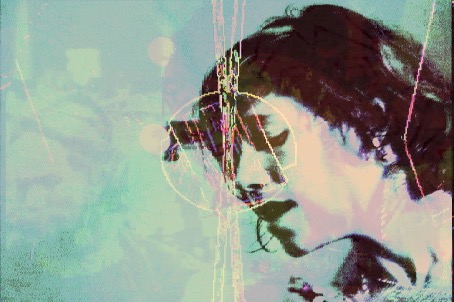
There is a little bit of absurdity in everything.
Self-portrait, DMT trance, performance art,
August 15th, 2005, Oakland, California.
Such experiences, steeped in art forms which are contemporary, yet parallel immemorial practices, have empowered the artist to comprehend the Naxi Dongba ethos in depth, while her exploration and studies in visual art have helped her develop the photographic temperament, the photographic eye.
The unity and concentration of the leitmotif as well as the power of her image signal the intensity of meditation.
The composition of the image is the fruit of intuition. It is well-balanced and seems effected in effortlessness. It is carried by ātman, the inner breath and the breath of nature in Hindu philosophy.
A painterly photography
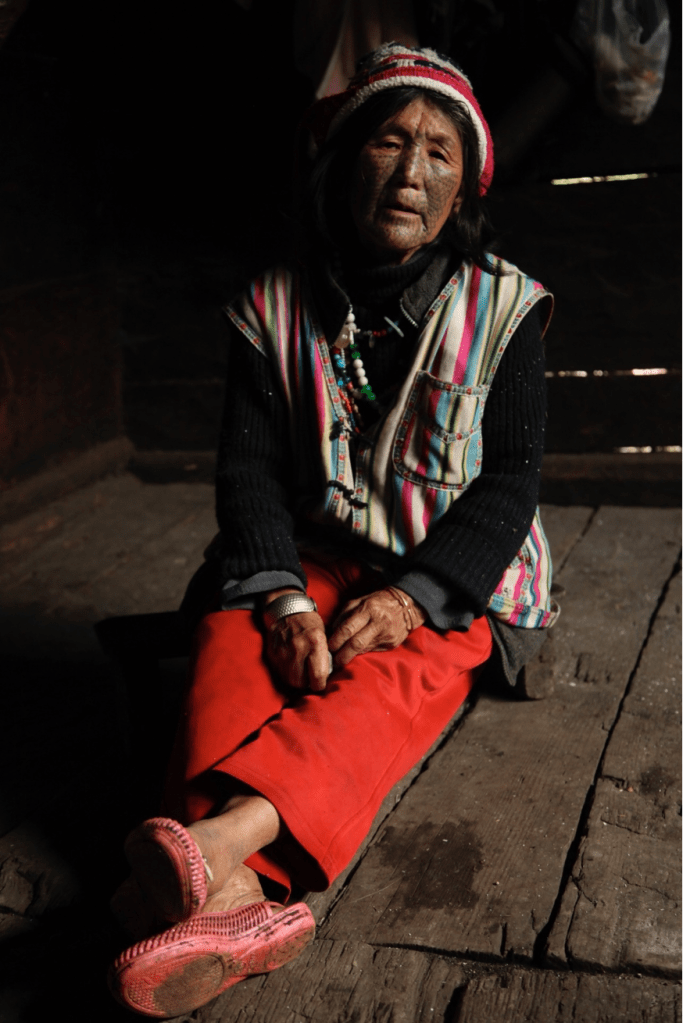
National jewel. Drung valley, Yunnan province, Southwestern China, 2012. Digital print.
There is an ineffable Zen quality in the portrait and the face of an old woman from the Drung valley, shot in the Yunnan province of southwestern China. The eyes open up on an internal world, an Other world. There is a kind respect, almost verging on reverence, in the photographer’s gentle gaze. It is important to know that Bérangère lays great emphasis on the connection with her maternal grandmother, who had Haitian Taino roots. The Taino are the original indigenous population of the island of Hispaniola, at present occupied by Haiti and the Dominican Republic. Here is an element in her lineage which possibly bears on her artistry.
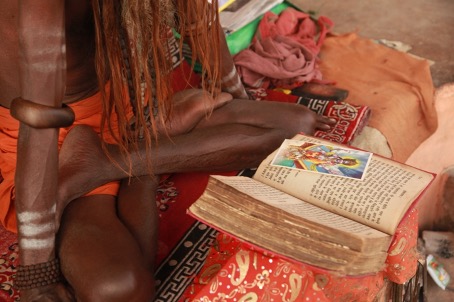
Yogi in sacred contemplation. Varanasi, Benares, Uttar Pradesh, Northern India, 2013. Digital print
The yogi’s brown shanks are flanked by his upright arms adorned with wooden rings, all being of the same hue. One senses great unwavering strength of spiritual origin. It is almost a trompe l’œil. The yogi’s body seems wrought of dark wood. The photographer resorted to deep curiosity, fierce attention, and concentration in securing such a scene. The sour cherry-coloured reddish carpet perfectly complements the body of the yogi.
This image attests to Parizeau’s refined sense of shades and colour harmonies.
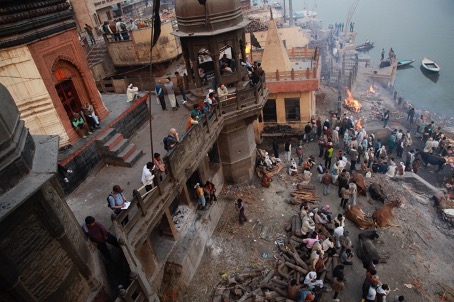
Manikarnika Ghat – The sacred shores of the Ganges. Varanasi, Benares, Uttar Pradesh, Northern India, 2013. Digital print.
This photographic take expresses a sense of the sacred. Therefore, language may not have the power to convey the atmosphere of this photo. Here art does what it must do: the image is playing a specific role, which defies the poetics of language.
Despite the short time span of the snapshot, this view of the Ganges somehow captures the ineffable of looking to eternity, highly evocative of the cremation ghats of Varanasi.
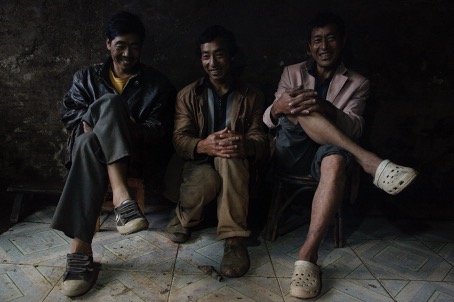
Naxi Dongba Chinese Minority. Wuxi village, Yunnan province, Southwestern China, 2012. Digital print.
There are three middle-aged men sitting on low stools, their smiles are curiously joyful. To us, the resplendent smiles are bewildering. What are they delighted with? Could they truly be satisfied with their simple existence? In their sense of being, they know it to be a great boon. I am certain, though, that their lives are full of trials. Yet, their faces show happiness of an origin other than sensuality or materialism. Bérangère seizes, again, the Zen of the moment. The Naxi Dongba men are present with the photographer. This kind of ethnographic documentary photography is the result of the collaboration between the photographed and the photographer, akin to a momentary dance. The smiles contain the essence of eternity or eternal joy. Their pure joy is the opposite of reification: the Naxi Dongba men sense the divine quality in time, as it seeps into consciousness, and their eyes reflect it generously. “I have never been in the presence of such playful people,” says the artist.
One must emphasize the photographer’s sense of chiaroscuro within images and of colour harmony. She is a master of gradations of colour shades: greys, earth tones, whites infused with tints of dark brown, sepia, dark green.
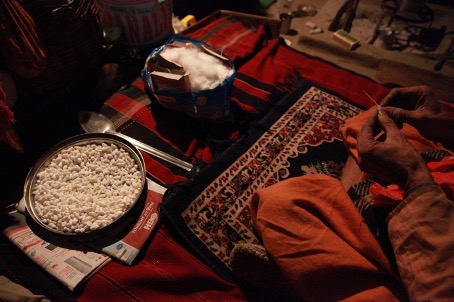
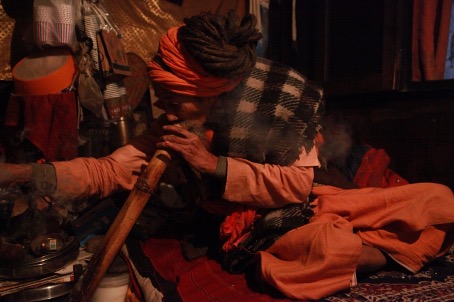
Cannabis Shamanism, diptych. Kamakhya Temple, Nilachal hills, Guwahati, Assam, 2013. Digital prints.
In this diptych, there are accomplished colour modulations of pink, yellow-orange, taupe, white, brown, and black in the criss-crossed bands of the blanket. The photography is painterly.
Parizeau shows virtuosity in geometric composition: the dark, jagged-looking diagonal shape marking the upper right corner of the lower image acts as a visual support, a benchmark against which the orange brown trousers and the headgear of the yogi are outlined.
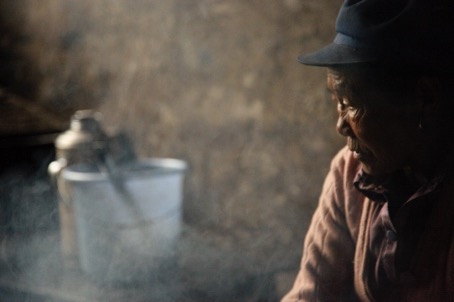
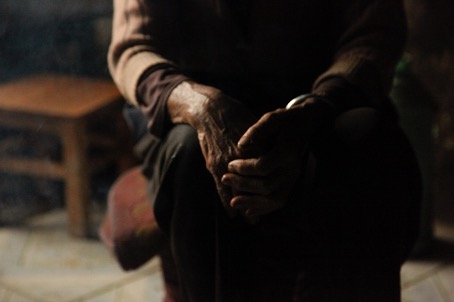
The immensity of peace and silence, diptych. Naxi Dongba Chinese minority, Yunnan province, Southwestern China, 2012. Digital print.
The graininess of the whitish-grey background highlights the interplay of the brown skin, black velvety trousers and the strong temperament showing in the Naxi Dongba woman’s face. The hands clasp each other in a powerful downward pointing movement, almost revealing the quality of deep-seated roots. The longish oversized hands seem to signal unusually great, very likely spiritual powers.
Let us draw a parallel with a significant representative of contemporary documentary photography, the Canadian Edward Burtynsky. In particular, Burtynsky investigates shipbreaking yards in Bangladesh, hence also in a region belonging to the Indian subcontinent or cultural sphere (Shipbreaking series, 2001). The laborious day routine of the workers shows through in his photography. These are historical and social documents. Yet, to my mind, his art is about the imminent sense of oppression, the hopelessness inherent in inequality, evidenced by the onerousness of the workers’ labour, the denseness of the environment as the here-and-now underlying reality of consumption capitalism. In most of his work, he also studies matter with its presence. In Burtynsky’s photography, the subject evokes the heaviness of materiality. And of course, intense chromatic study is an integral aspect of his oeuvre. While Burtynsky attests to the sociological dynamic aspect of a world which is subject to globalizing forces, Bérangère Parizeau focuses on an aspect of reality that is less emphasized in ethnographic documentary photography, and more difficult to grasp, perhaps: spiritual life. She has been successful in doing this in India and China, countries which for millennia have sensed the crucial role of spirituality, its complexity and, in the end, its unity and integration with everyday life. Bérangère Parizeau’s artwork is infused with the genuine essence of spirituality.
Her art also recalls the intricate images of 17th century Dutch genre painting, domestic scenes with painstaking realistic detail. One notes the mild quality of the light enveloping her individual and group portraits, and I cannot help but be reminded of Vermeer’s scenes. It is not about identity, but association by recall. “I only work with natural light and prefer to show people in their everyday environment,” says the artist. Her preference for warm hues and chiaroscuro contrasts likewise evokes the work of French baroque painter Georges de la Tour. Such evocations underline the painterliness of her photography.
Parizeau has also developed series of smaller-size geometric chromatic pattern digital prints, which characteristically display a strong self-confident taste in colour, picking up individual elements of her travel photography. The interplay of patterns has rhythmic musical qualities.
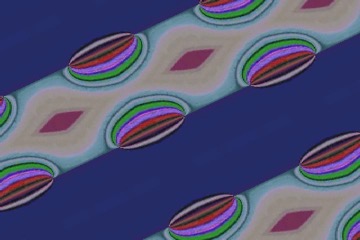
Trikaya (intra-dimensional DMT archetypal realm), 2023. Digital print.
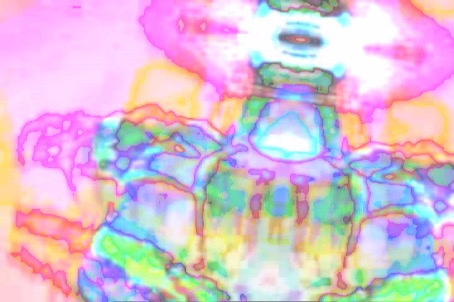
Angel Remix: Light & DMT spell, 2023. Digital print.
The artist develops a very personal spiritual realism with remarkable chromatic qualities and a sense of Other dimensions of existence, which may be more felt than said. The images capture slow time – or perhaps what may be termed an atemporal quality. She is carving herself a space in photography, as both a sensitive documentary ethnological photographer and a portrayer of spirituality, as one who feels profoundly and senses nuances.
Her artistic oeuvre points to what we are losing in the ongoing ecological crisis and in the advance of rampant transhumanism, the runaway proliferation of industrial and consumer technology: the feeling for the Earth, the interconnection with the cosmos, universal forces and how they interact with the psyche.
 André Seleanu